
Home / Our Stories /
Circular steel at scale: creating more value from what we already use
29 October 2026
By Victoria Sherwood, Chief Commercial Officer, InfraBuild
I’ve spent a significant part of my career working across recycling, resource recovery and industrial businesses. One thing that experience has taught me is that circularity is relatively easy to draw. Making it work commercially and operationally at scale is much harder.
It requires infrastructure and manufacturing capability, it needs sustained investment and reliable demand. Above all, it takes time.
Steel is a good example.
At InfraBuild, scrap steel is recovered and processed before becoming feedstock for our electric arc furnaces. We turn it into new steel, process and distribute it for use in Australian construction and infrastructure, and at the end of its useful life that steel can be recovered again.
We often describe this as a circular loop. I think of it as a value creation cycle, because each time material moves through the system, there is another opportunity to create value from it.
InfraBuild assets have been making steel in Australia since 1915, and our first electric arc furnace began operating in 1980. Today, the business consumes around 1.5 million tonnes of recycled scrap.
Over time, we’ve broadened our focus to other parts of the system: reducing operational waste, increasing our use of renewable electricity and continuing to lower the impact of steelmaking.
In FY26, more than 182,000 tonnes of our solid waste streams were recycled, representing 95 per cent and avoiding landfill. Our renewable power purchase agreements are contracted to provide renewable electricity equivalent to approximately 25 per cent of the electricity consumed at Sydney Steel Mill and Newcastle Rod Mill, and approximately 50 per cent of Laverton Steel Mill’s electricity requirements.
We’ll continue working on each of those areas, however when we asked ourselves what should come next, we looked beyond our own operations.
The construction industry is under pressure to build more while lowering carbon, containing costs and improving productivity. If we want to continue adding value to that industry, we need to help solve these problems too.
This led us to material efficiency and a fairly straightforward question: could we deliver the same structural performance using less steel?
That question led to SENSE 600®.
SENSE 600® combines higher-strength steel with an innovative bar design, allowing less steel to be used to deliver the same structural performance.
Depending on the application and design, that can mean up to 16.7 per cent less steel than conventional 500N reinforcement. It is manufactured from recycled scrap through our electric arc furnaces. Using the current NABERS comparison basis, it can deliver up to 56 per cent lower embodied carbon where the full 16.7 per cent mass reduction is achieved.
The product itself matters, however what I find particularly interesting is what happens when you remove those tonnes from the wider construction process.
There is less steel to buy and transport. Less to unload, move, lift and install. Depending on the project, that can have implications for freight, labour, crane use, handling, safety exposure, waste and time.
That’s where it starts to get interesting.
The value doesn’t stop with the quantity of steel purchased. It continues through the project, and some of the largest potential benefits may sit beyond the point where the steel itself is priced.
This also changes the conversation about sustainability. Rather than treating lower carbon as a premium, material efficiency creates the potential for sustainability and productivity to reinforce one another.
There is, however, an important condition.
The most value is captured when the material is considered early enough to influence the design. As the design becomes fixed, project teams have fewer options to optimise reinforcement or consider the wider implications for constructability, logistics, prefabrication and sequencing.
That doesn’t mean manufacturers should dictate design. Manufacturers, engineers, contractors, processors and project teams each hold different pieces of knowledge. Bringing those perspectives together earlier gives the project more choices while those choices can still improve the outcome.
The other part of the equation is procurement.
If we want different outcomes, we need procurement models that enable different solutions.
Too often, procurement processes are designed around transferring risk rather than managing it. That can unintentionally create barriers to innovation, even where the technical evidence is strong.
There is another way to approach it. Bring designers, manufacturers, contractors and asset owners together earlier, identify the risks collectively, and allocate them to the parties best equipped to manage them.
Innovation shouldn’t require one participant to carry all the uncertainty while everyone else benefits from the outcome.
We don’t need to choose between innovation and risk management. We need procurement processes that allow them to work together.
Developing an innovative product is one thing. Creating the conditions for the market to benefit from it is another. That takes evidence and confidence, but also collaboration, early engagement and procurement models that allow proven innovation to be considered.
For me, this is where the circularity conversation is heading.
We still need to recover more material and keep it in productive use. We also need to keep improving how that material is made, how efficiently it performs and how much value it creates through the broader system.
Australia needs more infrastructure, housing and renewable-energy capacity. Meeting that demand cannot simply mean using more resources in the same way we always have.
We need to make those resources work harder.
That is how circularity becomes industrial-scale resource productivity, and how we can help Australia build more with less.
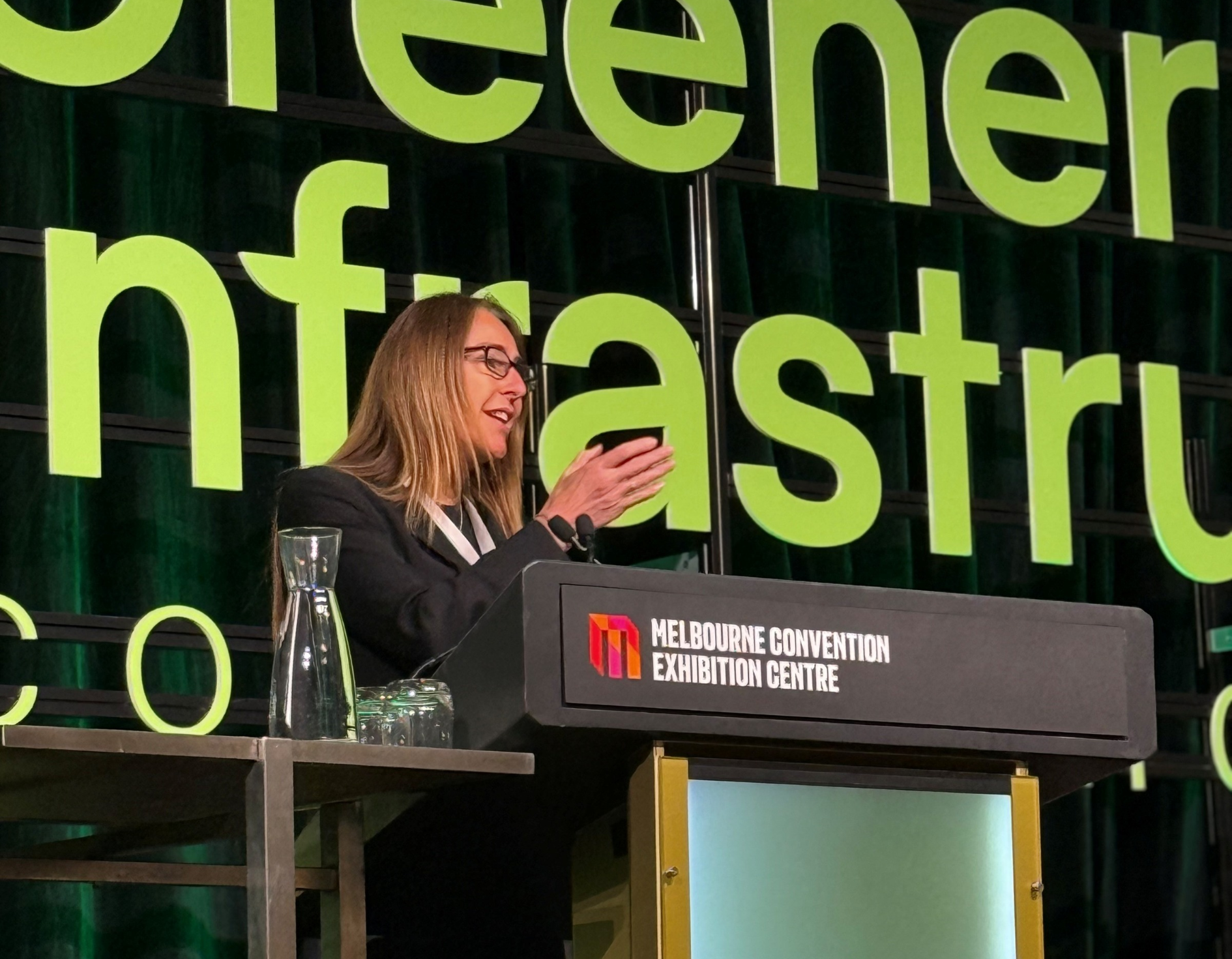
This article is based on a presentation delivered by Victoria Sherwood, InfraBuild Chief Commercial Officer, at the Greener Infrastructure Conference, where she shared her perspectives on circularity, material efficiency and the role of innovation in helping Australia build more with less.
Please contact us for any feedback or media enquiries about this content.
Subscribe to the
InfraBuild newsletter
Receive regular updates on news, case studies as well as the latest products and services.